dAILY dOGA ~ mINDFULLY lIVING AND lEARNING WITH DOGS     Paw  

Home

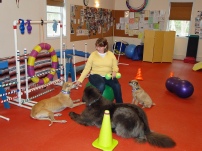
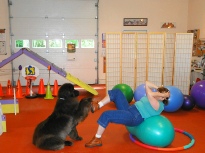
Daily Doga is a choice of mindfully living and learning with dogs.  It takes our training and living relationship with dogs to a more perceptive level that increases awareness, education and well-being.  Training your dog can change your life!    

The term yoga comes from a Sanskrit word meaning yoke or union.  Traditionally, yoga is a method joining the individual self with the Universal Spirit.  Physical and mental exercises are designed to help achieve individual goals.  Those who embrace yoga strive for a mindful way of living in the present moment and seek enlightenment.  

In the Eighteenth Century, the Age of Enlightenment did not represent a single school of thought.  Enlightenment was a set of values.  At its core was a critical questioning of traditional institutions, customs, and morals.  Buddhism posits it as seeking the truth. 

When practicing with dogs (doga), it is clearing the mind of clutter so we can focus on the moment, where dogs live and learn.  Dogs are naturally seekers.  Observe them sniffing, digging, exploring and playing with each other, then with humans.  They absolutely have emotions and associations, and are experts in reading body language.  Dogs are strongly instinctive.  We are intuitive (or can be).  Together, we are amazing.   

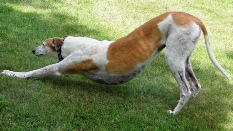
On the physical level, yoga postures, called asanas, are designed to tone, strengthen, balance, align the body and create flexibility.  These postures are performed to make the spine supple and healthy, and to promote blood flow to all the organs, glands, and tissues, keeping the bodily systems healthy.  Observe dogs when they awaken.  They stretch, yawn, arise and play bow.  Being individuals, like us, some are energetic while others ease their way into the moment. 

On the mental level, yoga uses breathing techniques (pranayama) and meditation (dyana) to quiet, clarify, and focus the mind.  Yoga is not a religion, but a way of striving to live healthy and with peace of mind.  As humans, we are not perfect.  We make mistakes.  So do dogs!  Mentally, dogs live in the present moment relying more on instinct, then on intuition.  We can use our intuition with the dog's instinct to discover new ways of communicating.      

Meditation is a practice of concentrated focus upon a sound, object, visualization, breathing, movement, or a created visualization.  The intention is to increase awareness of the present moment, reduce stress, promote relaxation, and enhance personal and spiritual growth.  Meditation techniques have been practiced for millenia.  Originally, they were intended to develop spiritual understanding, awareness, and direct experience of ultimate reality.  Meditation is a way of teaching us how to let thoughts flow, without becoming daunted or distracted, and even if we are, that's fine.  It is accepting.  Meditation can be 5 minutes or hours.  You can meditate and be aware at the time, like sitting at a red light in traffic.  There is no place else to go.  We can't control the red light, so may use this as an opportunity to breathe.  Sitting with our dogs in relative silence for even a few minutes before training helps to balance energy and get us focused. 
 
Stress is defined as an organism's total response to environmental demands or pressures.  Today, this is illuminated in techni-color on large screens, internet and Droids.  Do we know when enough is enough?  Dogs do.  Their symptom response is similar to ours, except they show it in body language, vocalization, destruction, aggression, submission (fight / fight / freeze / appease) or shutting down.  Sound familiar?  Amazingly dogs can teach us how to chill-out, live more calmly, and recognize when our "stress-meter" is in the red zone.  Take a deeb breath-- exhale.    

Stress in humans results from interactions between persons and their environment that are perceived as straining or exceeding their adaptive capacities and threatening their well-being.  The element of perception indicates that human stress responses reflect differences in personality, as well as differences in physical strength or general health.  Consider applying this to dogs who have to learn how to live in our stressful and emotional world. 

Risk factors for stress-related illnesses for humans and dogs are a mix of personal, interpersonal, and social variables that include lack or loss of control over one's physical environment and social support networks.  Consider shelter dogs, multi-dog house holds, dogs living in abusive environments along-side children.  People who are dependent on others (e.g., children, elderly, pets) or who are socially disadvantaged (because of race, gender, educational level) are at greater risk of developing stress-related illnesses.  Other risk factors include feelings of helplessness, hopelessness, extreme fear or anger, cynicism or distrust of others.  This equally applies to dogs living in a perpetual state of stress.

Through-out my life many connections have been meaningful and life-saving for me.  One I have always been grateful for is dogs.  Mentors, role-models, exercise and yoga are invaluable.  Energy flows in all beings, all of the time.  Some say even before and after we live or die.  Energy can be positively directed and managed, or flow out of control in too many directions at once.  Instead of enjoying life and our dogs, we begin to feel controlled by it.  Instead of riding the waves, we are drowned by them.  Shoveling sand against the waves is like trying to train a dog in a high state of stress, anxiety or fear.  A little stress is healthy.  It pushes our goals.  Too much clustered and continued stress for people or dogs, creates injury, illness and eventual breakdown.  The only safe place to go is within.  We see that in shelter dogs or dogs who live in abusive households who can become catatonic, fearful or aggressive (coping mechanisms).  They is a learned helplessness.      

As a behavior and wellness counselor, pet-assisted therapist, author and dog-training-coach for over 20 years, it makes sense to me that integrating this intentional concept of mindful living into training could only enhance our relationships with our dogs and others.  I have discovered it works for me, and works for even the most resistant or results-oriented go-getters.  Is it a magic bullitt?  No.  It requires a focused awareness and attention, strategy and flexibility.  It is kind of like being parachuted into a foreign country without a guide book.  Communication becomes scary, but something we figure out to survive.  It is like that for a lot of dogs who are launched into human households, who think that being part of the family means morphing into a human.  Dogs are a species of their own (
Canis Lupis Familiaris). 

Breathing, Centering, Canine Massage, Acupressure, Canine Stretch are part of Daily Doga Training & Connecting with our Dogs

For several years I have been integrating canine massage, stretch, breathing and relaxation into training classes for dogs.  The benefits are mutual and effective!  It is quickly catching on that training our dogs does not start and stop.  It is on a continuum, as an integrated part of our life with dogs.  I know this for sure, after working with hundreds of dogs over a lifetime, that if a person or dog is not focused and present, learning becomes more difficult if it happens at all.  Dogs know when we are being genuine.  They learn when it makes sense and benefits their well-being.   

I hope you enjoy this website as it grows.  Join me in my passion quest to make a difference for dogs.  Share your stories about our how dogs have changed your life!    

Doga Mantra:  Do something for me and I'll do something for you -- let's enjoy the journey ~  
We Must be the change we wish to see in the world.  Mahatma Gandhi ~